GRP vs FRP: What Is the Difference? A Clear Guide from Qatar's Leading Supplier of Both
If you have been researching construction materials or industrial products for a project in Qatar, you have almost certainly come across both GRP and FRP as terms for what appears to be very similar products. Tanks, ladders, cladding panels, gratings, and waterproofing systems are all described using both acronyms, often interchangeably. So what is the actual difference between GRP and FRP, and which one does your project need?
At Merac International, we specialise in supplying, installing, and manufacturing both GRP and FRP products across Qatar. With over 5 years of experience delivering high-quality fiberglass solutions for residential, commercial, and industrial clients, we are well placed to clear up the confusion and help you choose the right material for your project.
What Does GRP Stand For?
GRP stands for Glass Reinforced Plastic. It is a composite material made by reinforcing a polymer resin with glass fibres. The glass fibres provide strength and stiffness while the resin binds them together and protects against moisture, chemicals, and environmental exposure.
GRP is the term most commonly used in the UK, Middle East, and GCC region, including Qatar. When Merac International and other Qatar-based suppliers refer to GRP products, they are describing products manufactured from glass fibre reinforced plastic composites.
What Does FRP Stand For?
FRP stands for Fibre Reinforced Plastic (sometimes written as Fiber Reinforced Plastic in American English). It is a broader term that describes any composite material where a polymer resin is reinforced with fibres, which can include glass fibres, carbon fibres, aramid fibres, or basalt fibres.
FRP is the term most commonly used in North America, India, and parts of Asia. When clients or technical specifications refer to FRP in Qatar, they are almost always referring to glass fibre reinforced products, making FRP and GRP effectively the same material in the majority of construction and industrial applications.
GRP vs FRP: What Is Actually the Difference?
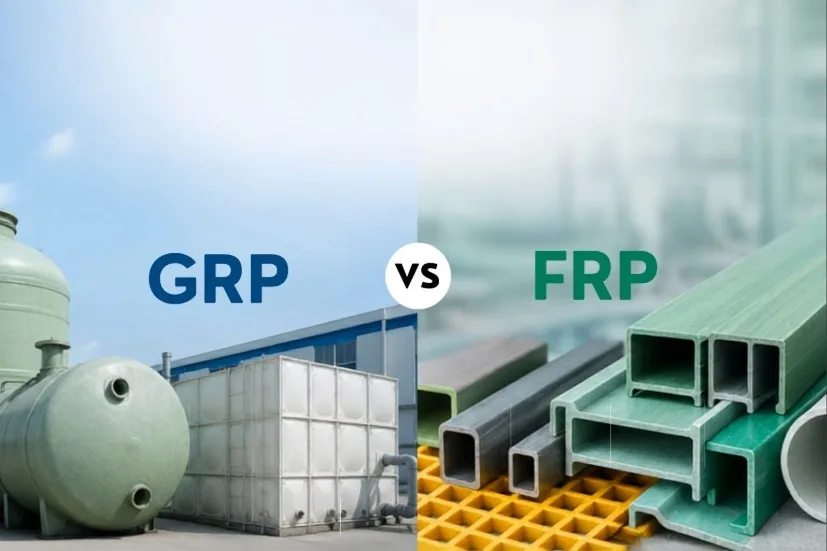
Here is the clearest answer: in most practical construction and industrial applications, GRP and FRP refer to the same material. Both describe a composite of glass fibres embedded in a polymer resin matrix. The difference is primarily one of terminology and geography, not material composition.
| Factor | GRP | FRP |
|---|---|---|
| Full Name | Glass Reinforced Plastic | Fibre Reinforced Plastic |
| Common Region | UK, Middle East, GCC, Qatar | USA, India, parts of Asia |
| Reinforcement | Glass fibres | Glass, carbon, or other fibres |
| In Qatar Construction | Most common term used | Also used, same product |
| Material | Glass fibre and polymer resin | Fibre and polymer resin |
| Performance | Identical in glass fibre form | Identical in glass fibre form |
| Interchangeable? | Yes in most applications | Yes in most applications |
When Does the Difference Between GRP and FRP Actually Matter?
While GRP and FRP are interchangeable in most glass fibre applications, there is one important distinction worth knowing: technically, FRP is a broader category that can include non-glass reinforcement materials.
Carbon Fibre FRP
Carbon fibre reinforced plastic (CFRP) is a type of FRP that uses carbon fibres instead of glass. It offers higher strength and lighter weight but is significantly more expensive. Carbon FRP is used in aerospace, high-performance automotive, and specialist structural engineering but is not commonly used in Qatar's construction or industrial sectors.
Aramid Fibre FRP
Aramid fibre reinforced plastic uses Kevlar or similar fibres for applications requiring impact resistance and ballistic protection. Again, not typical in standard construction or industrial applications in Qatar.
For Qatar's Construction and Industrial Sector
In Qatar's construction, infrastructure, oil and gas, and industrial sectors, when a specification, supplier, or client refers to either GRP or FRP, they are virtually always referring to glass fibre reinforced plastic. The terms are used interchangeably across the region and both refer to the same material and product performance characteristics.
GRP and FRP Products Supplied by Merac International in Qatar
Merac International specialises in providing both GRP and FRP products and services for residential and industrial requirements across Qatar. With over 5 years of experience and a reputation built on delivering high-quality products and exceptional customer service, Merac is Qatar's preferred provider of GRP and FRP solutions.
Our GRP and FRP product and service range includes:
- GRP and FRP lamination and waterproofing for roofs, tanks, pools, manholes, and structures
- GRP and FRP cladding supply and installation for building facades and wall systems
- Roof curb installations for pre-engineered and commercial buildings
- GRP and FRP ladders, gratings, and chequered plates for oil and gas facilities
- GRP and FRP cable trays for electrical and utilities infrastructure
- GRP storage tanks and chemical tanks for water and industrial storage
- GRP manhole lining and lamination for sewage and drainage infrastructure
- GRP enclosures, drip trays, and sealing plates for industrial applications
- Structural designing services for residential and industrial projects
Which Should You Specify: GRP or FRP?
For the vast majority of construction and industrial projects in Qatar, you can use either term in your specification and the product you receive will be the same. However, here are some practical tips:
Use GRP when:
- Your project is based in Qatar, the GCC, or the UK region
- Your specification follows British Standards or Middle East construction norms
- You are sourcing cladding, waterproofing, tanks, manholes, or architectural GRP products
- You are working with local Qatar-based suppliers and contractors
Use FRP when:
- Your project specification follows American or Indian standards
- You are sourcing oil and gas products such as gratings, ladders, and cable trays
- Your technical documentation originates from a US or Indian engineering team
- A project consultant or client specifically requests FRP terminology
In all cases, Merac International can supply and install the right product regardless of which term is used. Our team understands both GRP and FRP specifications and will ensure you receive the correct product for your project requirements.
Frequently Asked Questions
Is GRP stronger than FRP?
When both refer to glass fibre reinforced products, GRP and FRP have identical strength characteristics. The strength of the product depends on the resin system, glass fibre content, and manufacturing process, not on which term is used to describe it.
Does Merac International supply both GRP and FRP products?
Yes. Merac International specialises in supplying, installing, and manufacturing both GRP and FRP products for residential and industrial clients across Qatar. Our product range covers lamination, waterproofing, cladding, tanks, ladders, gratings, cable trays, and more.
Which term is used more in Qatar?
GRP is the more commonly used term in Qatar and across the GCC region. However, FRP is also widely understood and used, particularly in oil and gas specifications and by clients with engineering teams from North America or India.
Can Merac International advise which product is right for my project?
Yes. With over 5 years of experience delivering GRP and FRP solutions across Qatar, Merac International's team can assess your project requirements and recommend the right material, product type, and specification. Contact us today to discuss your project.
Need GRP or FRP Products for Your Qatar Project?
Whether your specification says GRP or FRP, Merac International has the products, expertise, and 5+ years of Qatar experience to deliver the right solution for your project. Contact our team today.